The X-factor in Curing: A Clinical Look at the VALO™ X
We, as clinicians, in general, want products that answer one question: Will this product help me be better, faster, predictable, and more profitable? In clinical dentistry, we want efficiency, better ergonomics, consistent curing penetration, reliable battery life, and ease of access in the posterior teeth (especially with those with limited opening). Investing in a good dental curing light is critical in the success of our clinical outcomes. I, personally, want to be able to sleep at night knowing that my restorations are cured fully.
Dental curing lights were born in the 1960s, when the first light-curing resin was developed. Since then, we have advanced dental curing lights from using UV light, quartz-halogen bulb lights, plasma arcs, and now to LED curing lights. Since the introduction of LED curing lights in the 1990s, we have gone through four generations of development, with each generation improving their power output, irradiance, wavelength, and heat dissipation.
When you're evaluating a curing light, there are three things that really matter: irradiance, wavelength spectrum, and beam profile. Most companies love to advertise irradiance (mW/cm²), but that number alone doesn't tell the whole story.
Let's Start With The Basics
Remember high school physics? Watts (W) measure the total power output of the light. Think of it like a garden hose. Watts are the total amount of water flowing through the hose.
Now mW/cm² is different. It measures how concentrated that power is over a specific area. Using the same garden hose analogy, it's like putting your thumb over the end of the hose. The amount of water coming out hasn't changed, but now it's concentrated into a smaller stream, so it feels much stronger.
The same thing can happen with curing lights. A manufacturer can take the exact same total power and simply make the light tip smaller. Suddenly the irradiance number looks much higher, even though the light isn't actually producing more power. That's why chasing the highest mW/cm² can be misleading if you don't understand what's behind that number.
Wavelength Spectrum
The second thing to look at is the wavelength spectrum. Not all composites use the same photoinitiator anymore. While camphorquinone has been the gold standard for years, many modern composites now incorporate initiators like TPO, Ivocerin, and PPD, each of which responds to different wavelengths of light. If your curing light only emits a narrow wavelength, it may not fully activate every photoinitiator in the composite you're using. That can lead to incomplete polymerization, even if the irradiance is high.
Beam Profile
Finally, pay attention to the beam profile. This is one of the most overlooked features of a curing light. Ideally, you want a beam that delivers light evenly across the entire tip. Many lower-cost curing lights produce "hot spots" in the center, with weaker light around the edges. That uneven distribution can leave portions of the restoration undercured, increasing the risk of wear, marginal breakdown, postoperative sensitivity, and, ultimately, restoration failure.
At the end of the day, a great curing light isn't just about having the highest irradiance. It's about having the right combination of adequate power, the appropriate wavelength spectrum, and a uniform beam profile. When all three work together, you give your restorations the best chance for long-term success.
VALO™ X Hits All Three Marks
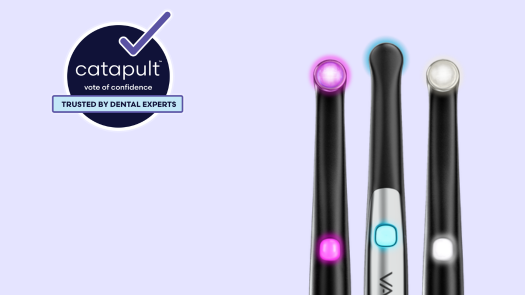
The Ultradent Valo X hits all three marks-irradiance, wavelength, and beam profile. My initial impression of the Ultradent Valo X is very positive. The curing light features a lightweight aluminum handpiece that feels durable and well balanced in the hand. Its dual-button design allows activation from either the top or bottom, making it comfortable to use regardless of grip preference.
One of the many standout features was the head profile of the curing light. Many competitors make the head of the curing light too bulky, making it difficult to get to posterior regions of the mouth. The Valo X curing light head is sleek in design, measuring a little over 6 mm in height, making it maneuverable in the most limited openings and the distals of the posterior teeth. The curing tip area was also much wider compared to other competitors, allowing more light to come out.
Another standout feature is the inclusion of two rechargeable batteries. This allows one battery to remain in use while the other charges, minimizing downtime and making the system well suited for busy clinical environments.
Noteworthy Features & Additional Tips
Another new and noteworthy feature is both a curing mode and a diagnostic aid mode, with switching between the two modes accomplished by simply waving the handpiece. This gesture-based interface is intuitive and eliminates the need for additional buttons or complicated menus.
When diagnosing cracked teeth or restorations, waving the curing light and then shining the bright white light on the tooth while taking an intraoral photo was easy. The black light mode helped in identifying orthodontic buttons when removing them. The kit also includes a 12.5-mm magnetic diffuser lens that can be quickly attached, removed, and disinfected. Ultradent further expands the system with optional accessories, including transillumination, interproximal, and point cure lenses, adding versatility beyond routine composite curing.
From a performance standpoint, the Standard Power mode delivers approximately 1,350 mW of total power with an irradiance of 1,100 mW/cm² over 10 seconds, resulting in an energy delivery of 13.5 J. The Extra Power mode increases output to approximately 2,700 mW with an irradiance of 2,200 mW/cm² over five seconds while delivering the same total energy of 13.5 J. All of this energy in a large curing tip area with a diameter of 12.5 mm is unheard of and a great reason to purchase this curing light. Also, the effective wavelength ranged from 380 to 515 nm, covering most composite photoinitiators.
There are some additional tips I would like to share with readers about having light as part of your diagnostic armamentarium. The new features of the dark light and the white light mode were extremely useful when trying to get more light into the patient’s mouth or diagnosing cracks [Figure 1].
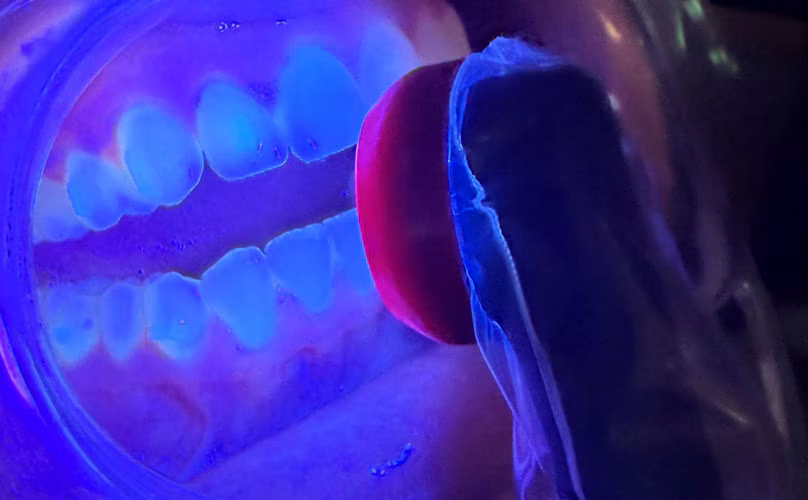
[Figure 1] Clear aligner attachments visualized using the Valo X black light diagnostic feature, providing enhanced visualization of clear aligner attachments for easy removal.
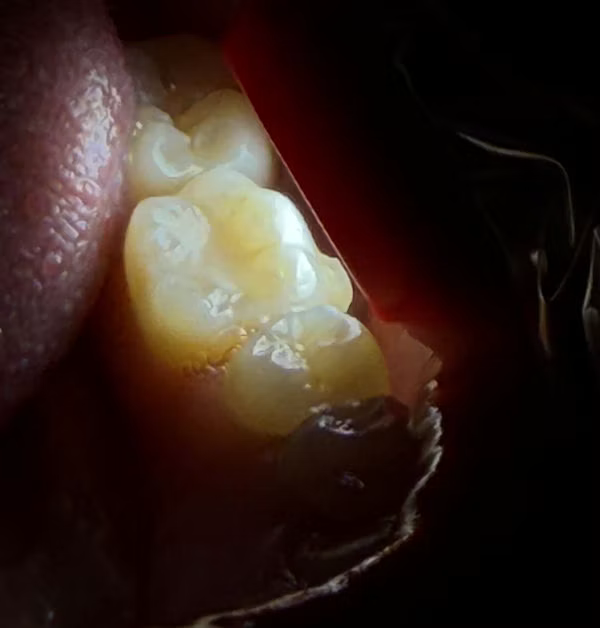
[Figure 2] With a narrower tip profile, the Valo X is able to reach into the tight posterior regions of the mouth.
Loupe lights can only penetrate so far back in the mouth, but having the Valo X allowed me to see things clearly. Another tip is using the light to remove orthodontic attachments. Another tip is using the black light feature to help identify a clear aligner [Figure 2]. This definitely helps me in making sure I only remove the attachments completely.
Conclusion
The clinical evaluators at Catapult Education reviewed and tested the Valo X curing light from Ultradent Products Inc. Sixteen evaluators incorporated the Valo X into their daily clinical workflows over several weeks, assessing its curing performance, ergonomics, durability, access, diagnostic capabilities, and overall ease of use.
The Valo X received strong marks for its curing performance and consistency. Ninety-four percent of evaluators rated its light output and uniformity as excellent while 94% also reported being very confident in the depth and completeness of cure. One evaluator commented:
Excellent engineering, easy to use, every mode and option is well thought out.
Beyond curing performance, evaluators consistently highlighted the Valo X’s dependability, comfortable ergonomics, durable construction, and integrated diagnostic capabilities as key strengths. Its versatility was particularly well received, with 81% of evaluators rating its ability to transition between different clinical procedures as excellent.
The white light transillumination and the dark light feature emerged as a valuable addition to the device, with evaluators incorporating it into their workflows to assist in identifying cracks and caries in addition to performing routine restorative procedures. As one evaluator noted, “The transillumination was a VERY nice and useful feature. I used it for cracks and caries detection.”